Goldfinch
Species: Goldfinch
Latin name: Carduelis carduelis carduelis
English name: Goldfinch
Order: Passeriformes
Family: Fringillidae
Description:
A few years ago, whilst reading the AOB’s magazine *Le monde des Oiseaux*, I came across Herrmann Heinzel’s magnificent colour plates depicting various colour morphs of passerines.
Among these engravings was a Goldfinch with a very strong dilution, which I had long marvelled at, as its pastel hues really brought out its red mask and wing mirrors. Time has passed, and I have been fortunate enough to breed goldfinches with these colour variations and to observe them in the collections of various passionate amateur breeders. Here, then, is a presentation of these various mutations, which I hope will be of interest to you. These few lines serve to demonstrate that in this magnificent cardueline (as in many others), genotypic and phenotypic changes sometimes occur that are worth preserving and understanding.
Before exploring these colour variations, let us take a moment to review the wild-type phenotype of the goldfinch:
WILD-TYPE PHENOTYPE:
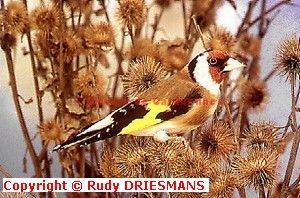
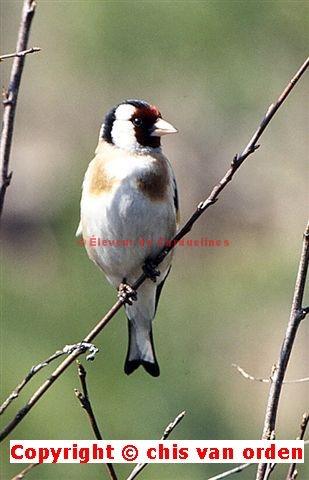
There is no sexual dimorphism between male and female Goldfinches. The Goldfinch’s head is elongated and features a red mask, framed by black. Its back is brown, and its wings are black with bright yellow wing bars. The rump is whitish or white, depending on the subspecies. The tail is black with whitish bars, the size and number of which vary according to the subspecies. The breast is white, surrounded by brown spots arranged in the shape of a mushroom. The beak is pinkish with a black line on the upper mandible outside the breeding season (entirely pink during the breeding period).
Sexing these birds is not easy due to the lack of sexual dimorphism. However, with a little practice, the following criteria can be used to select breeding birds. These criteria are, however, less obvious when dealing with a mutation involving very high melanin dilution.
Upon observing the pattern of the red mask, it becomes apparent that most male goldfinches have an irregular outline that extends beyond the eye and forms an extension down the sides of the head. The female has a more subtle and circular red mask (we shall see later that certain mutations no longer have a red mask, but an orange-red mask, sometimes ivory-orange; in such cases, the extension beyond the eye is much less obvious to discern).
It is also necessary to examine the scapular feathers covering the bird’s shoulders (inter-alary tectorials). In the wild-type phenotype, these small feathers are grey-brown in the female and deep black in the male. In mutant individuals, a difference in pigment intensity can also be observed.
In many males, a few small yellow feathers can be found amongst the underfeathers, in the area of the white patch on the breast, which are absent in most females. In immature birds, this detail is also useful for sexing. Please note, however, that some older females may have a few yellow underfeathers.
Nevertheless, by taking these various observations into account, you can get a good idea of the sex of the birds in your care and avoid making any mating mistakes. When goldfinches are in peak condition, in late April or early May, they can be seen displaying before mating (see video on this page).
Galerie